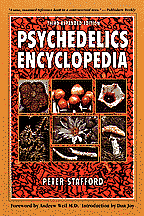
 Third Expanded Edition BUY THIS BOOK from Amazon
"Stafford's is a sane, reasoned reference book in a controversial area where politics and criminal penalties have kept research and public knowledge at a minimum."  -Publishers Weekly -New Age Journal -Publishers Weekly -New Age Journal
|
Psychedelics
Encyclopedia Peter Stafford Introduction by Dan Joy Foreword by Andrew Weil, M.D.
Psychedelics Encyclopedia draws from scientific research, personal accounts, and popular literature to document the properties attributed to psychedelic substances, their preparation and use, and the shifting social attitudes toward them over the past half-century. Psychedelics Encyclopedia is a remarkable sourcebook for anyone interested in the psychological, biological, physiological, and cultural aspects of psychedelics. Information on the history, botany,
pharmacology, physical effects, mental effects, forms,
and sources for: + The LSD Family
In a curious circle of
coincidence, knowledge about the psychoactivity of
the natural groups came along only after the
synthesis of LSD by Dr. Albert Hofmann. Unlike
most chemists, who even today work mainly with
synthetics, Hofmann was drawn toward study of
natural substances at the end of the 1920s. Under
the supervision of Dr. A. Stoll, who isolated the
first ergot alkaloid in a pure chemical form,
Hofmann later synthesized a number of ergot
analogues (closely related compounds) at Sandoz
Pharmaceuticals in Switzerland.
|
 sychedelics
Encyclopedia is a fascinating historical
reference on psychedelics -- from the LSD-25 of the
'60s to the memory enhancers of today.
sychedelics
Encyclopedia is a fascinating historical
reference on psychedelics -- from the LSD-25 of the
'60s to the memory enhancers of today. 
BACK
Delerium's Psychedelic Web 
Timothy Leary books
& videos available.
And more!
Cutting edge info for psychonauts.
Learn the latest on ecstasy & LSD research - and more!
Back to Psychedelic
Index