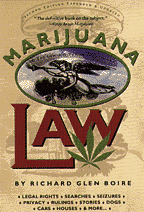
Law/Marijuana With isbn, you can order this book through any
bookstore in the world. Pick up at the store - no ship
fee. Marijuana Law <>
Richard Glen Boire, ESQ. Boire is the Director of the
Center for
"Marijuana Law gives us the legal armaments with which to resist unfair police methods. [Boire's] book contains the most important things about marijuana law that a user must know."Ê  -J. Tony
Serra,
Attorney at Law -J. Tony
Serra,
Attorney at LawReview by Russ Kirk in
Outposts 2 Asset Forfeiture CAFR Review of Top
News from the Center for Cognitive Liberty
|
Marijuana Law,
2ed A Comprehensive Legal Manual Richard Glen BoireÊ Foreword by J. Tony SerraÊ  n Marijuana Law, Richard Glen Boire explains
marijuana laws and how they can impact upon citizens'
rights. He describes how
people have been arrested and prosecuted and how
to increase privacy protections and reduce exposure to
arrest.Ê n Marijuana Law, Richard Glen Boire explains
marijuana laws and how they can impact upon citizens'
rights. He describes how
people have been arrested and prosecuted and how
to increase privacy protections and reduce exposure to
arrest.Ê
Richard Glen Boire is also the author of Sacred Mushrooms & the Law.
Among the general public, the law concerning consent is perhaps the most misunderstood. The general rule is that if a person consents to a warrantless search, the search automatically becomes reasonable and therefore legal. Consequently, whatever an officer finds during such a search will be used to convict the person. Simply put, if a person consents to a search, he has waived the primary protection offered by the Fourth Amendment.Ê The sad fact is that most people believe that when an officer approaches them and asks permission to search their person or enter their home, that they are required to grant the officer's request. The truth is the exact opposite -- you have a right to associate with and speak to whomever you please. In this respect, there is nothing special about a police officer. Whenever a police officer asks your permission to search, you are under no obligation to consent. The only reason he is asking is that he doesn't yet have enough evidence to forcibly search. By consenting you are giving up one of the most important constitutional rights you have.
This expanded 2nd edition contains the
latest information on the necessity defense in medical
marijuana cases, drug testing, case law, and federal
sentencing guidelines. It also contains practical tips
on individual rights and avoiding surveillance. You
will find appendices on the Bill of Rights, wallet cards ,
state-by-state punishment for marijuana crimes, and
the 13 federal circuits, as well as a thorough index.
HOW MR. PUFF PROPERLY ASSERTED HIS CONSTITUTIONAL RIGHTS:Ê Officer Friday stopped Mr. Puff's vehicle because his registration was expired, and asked Mr. Puff, "Would you please empty the contents of your pockets?"Ê Mr. Puff properly said, "Are you asking me to empty my pockets, or are you ordering me to empty my pockets?" When Friday said he was simply asking, Mr. Puff properly said, "No thanks, and I really must be going." going. Analysis: Mr. Puff's question to Friday was entirely appropriate. In fact, Mr. Puff's response was an effective method of turning the table on the officer. If Friday had told Mr. Puff that he was ordering him to empty his pockets, Mr. Puff could have properly responded, "Get a search warrant. I do not consent to your search and would like to continue on my way." That way, if the officer had proceeded to search Mr. Puff's pockets without a warrant, Mr. Puff's lawyer could argue that the search was illegal. If Mr. Puff had consented, his lawyer would have no argument. |