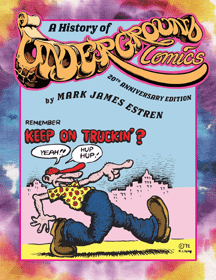
20th Anniversary Edition
$29.95 BUY THIS BOOK  "Enthusiastic and intelligent homage to the scabrous, anarchic outrageous adults-only comics . . . An excellent slice of 1960s Americana as well as unique pop-cultural history."  - Booklist- Midwest
Book Review - Booklist- Midwest
Book Review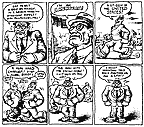 "Both a landmark study in its field and a book which is just plain fun to read." - TV News/Greenwich Village "In the highly politicized atmosphere of the mid '60s, these new comics were a much needed, usually humorous counterpoint to the dead seriousness of the underground press in which many of them first appeared." -- Buffalo (New York) Reporter "Seems to me you've displayed plenty of affectionate respect for even the lowliest just or being part of a movement, but kept a clear eye on their actual achievements, and organized the whole with clarity and style. How's that for a rave?" -- Bill Pearson, " Witzend" "It's a great book. There is nothing like it anywhere." -- The Fifth Estate "A massive job and a highly successful one." -- The Buyers' Guide "Estren's book is one of the best studies of comic art in print." -- Seattle Times "A long, loving, yet still perceptive look at the artwork, the philosophies and the satire." -- Santa Barbara News-Press "Lavishly illustrated, with ample examples of not only underground artists but several who set many of the trends and styles in earlier days." -- San Francisco Sunday Examiner & Chronicle -------- VISIT Mark Estren's website |
20th Anniversary
Edition
History of
Underground Comics Mark J. Estren
The first and most
comprehensive look at the underground cartoonists and
their work -- lavishly illustrated, including comments
and drawings by the cartoonists themselves and by
members of the earlier generation that most influenced
them. Includes the full story of the notorious
obscenity trial of Zap
#4 including the panels.
In his "social realism" strips, R. Crumb does not mock American society; rather, he presents it for what it is and trusts the reader eventually to realize that the strips are funny because the society is absurd. Crumb has not been the only underground cartoonist to attempt this special brand of social realism. On occasion, J. Kinney has also worked in this manner. Kinney describes his approach as follows: "I try to put down on paper relatively true visions of middle-class life as I see it. . . . Hopefully by capturing all this on paper, I can help people to see themselves more objectively and insightfully. Heheheheheh." "This history will be a revelation to many
comix fans." --
Atlanta Journal "A generous genealogy of this warped genre." --
Swank
All
Meat |
 ince the genre first emerged in the late
1960s, underground comics (or "comix") have delighted
and outraged millions of people. The exploits of such
characters as Mr. Natural and The Fabulous Furry Freak
Brothers embodied the psychedelic era and continue to
attract loyal readership today.
ince the genre first emerged in the late
1960s, underground comics (or "comix") have delighted
and outraged millions of people. The exploits of such
characters as Mr. Natural and The Fabulous Furry Freak
Brothers embodied the psychedelic era and continue to
attract loyal readership today. 
